On this 2nd day of Elul, I’d like to share a couple of things about the Hebraic way of thinking and understanding Scripture. The first thing for us to remember is Hebraic thinking is circular as opposed to Western thinking which is more linear. The explanation sounds more artistic than cultural; however, it affects much of our understanding of the Scriptures.
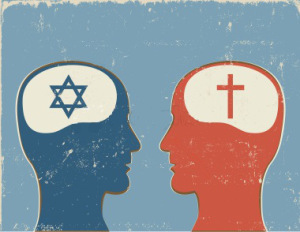
To help us see some of the differences, here is a very linear chart that compares the two ways of thinking:
| Western Approach | Hebraic Approach |
| Life analyzed in precise categories. | Everything blurs into everything else. |
| A split between natural & supernatural | Supernatural affects everything. |
| Linear logic | Contextual or “block” logic |
| “Rugged Individualism” | Importance of being part of group |
| Equality of persons | Value comes from place in hierarchies |
| Freedom orientation | Security orientation |
| Competition is good | Competition is evil (cooperation better) |
| Man-centered universe | God/tribe/family-centered universe |
| Worth of person based on money/material possessions/power | Worth derived from family relationships |
| Biological life sacred | Social life supremely important |
| Chance + cause & effect limit what can happen | God causes everything in his universe |
| Man rules nature through understanding and applying laws of science | God rules everything, so relationship with God determines how things turn out. |
| Power over others achieved through business, politics and human organizations. | Power over others is structured by social patterns ordained by God. |
| All that exists is the material | The universe is filled with powerful spirit beings |
| Linear time divided into neat segments. Each event is new. | Cyclical or spiraling time. Similar events constantly reoccur. |
| History is recording facts objectively and chronologically. | History is an attempt to preserve significant truths in meaningful or memorable ways whether or not details are objective facts. |
| Oriented to the near future | Oriented to lessons of history |
| Change is good = progress | Change is bad = destruction of traditions |
| Universe evolved by chance | Universe created by God |
| Universe dominated and controlled by science and technology | God gave man stewardship over his earthly creation. Accountability to God. |
| Material goods = measure of personal achievement | Material goods = measure of God’s blessing |
| Blind faith | Knowledge-based faith |
| Time as points on straight line (“at this point in time…” | Time determined by content (“In the day that the Lord did…”) |
Sources: Irrational Man, by William Barrett; Christianity With Power by Charles Kraft; Hebrew Thought Compared With Greek by Thorleif Boman; Judaism and Christianity – The Differences by Trude Weiss-Rosmarin, Our Father Abraham, by Marvin Wilson, God in Search of Man by Abraham Heschel.
Abraham Heschel was a Rabbi, theologian, and Jewish philosopher. He wrote, “To try to distill the Bible, which is bursting with life, drama, and tension, to a series of principles would be like trying to reduce a living person to a diagram” – God in Search of Man by Abraham Heschel, p. 20. When we study Scripture, or when we consider the nature of the early church, we must take into account the myriad differences between Hebrew and Greek thought. Intellectually, we are Greeks, not Hebrews. We apply Aristotelian and Socratic thought patterns to practically everything. It is difficult for us to enter into the Hebraic mindset. We tend to try rendering everything into logically consistent patterns, on systematizing it, on organizing it into tight, carefully reasoned theologies. We have difficulty living with inconsistency or contradiction. We tend to define everything and neatly compartmentalize our faith and our life. We cannot live with the Hebraic idea that God is simply ineffable, and that God’s Book doesn’t lend itself to systematization.
The Western mind tends to organize everything into manageable intellectual blocks and structures. We want all questions answered, all problems solved, and all contradictions resolved. But, “To the Jewish mind, the understanding of God is not achieved by referring to a Greek way to timeless qualities of Supreme Being, to ideas of goodness and perfection, but rather by sensing the living acts of His concern, to His dynamic attentiveness to man. We speak not of His goodness in general but of His compassion for the individual man in a particular situation” (Heschel, p. 21).
A good example of the difference in thinking can is seen in the English word “faith.” Our Greek mindset equates belief with faith, but that is not the Jewish way. Belief is only a component of faith in Jewish thinking; however, it is far more than simply belief. Hebrew “faith” is steadiness, steadfastness, persistence, loyalty, firmness and fidelity. If you could just use one English word to describe it, it would be faithfulness. In fact, the opposite of faith in Hebrew thinking is not unbelief but rather disobedience.
The basis of your entire relationship with God is related to his faithfulness, which should draw forth your faithfulness. Anyway, that is another discussion for another day. The only purpose here is to draw your attention to the difference in Hebraic thinking and Greek (Western) thinking.
The reason all of that was important to include is because of our second point. Jewish sages and Rabbis approach Scripture with a different mindset. They look at Scripture as having levels of understanding or interpretation. The levels are as follows:
- Peshat (simple) – the plain or primary meaning. It is the “face value of a text.”
- Remez (clue) – the allegorical. It links concepts and ideas of the text or texts.
- Drash (to explain, to inquire) – the homiletical. It is the personal application of the text.
- Sod (secret) – the mystical. It is searching for deeper and more intimate meaning in the text.

Now, each of the levels remains within the boundaries of Biblical truth and morality. Each level also complements the other levels while allowing an exploration of the many levels of Scripture. Although there is vast exploration, the parameter of exploration is to recognize and respect the character and nature of God. The name of God must always be honored and glorified.
It is important to understand the above discussion (as brief as it is) because when expounding on a topic like the Last Days or the Rapture many of the arguments against such teachings don’t consider Hebraic thinking or interpretation when they come to their conclusions.
With that in mind, let us consider why Jewish Feasts matter.
 for those who are interested
Leave a comment